Supersets and Circuits: Shorter Workouts, Better Results
Work, traffic and family responsibilities mean many people only have 40 to 50 minutes for the gym. If you keep cutting sessions short, supersets and circuits are two practical, evidence-based methods that help you get enough training volume done in less time while keeping your heart rate up. Research shows that when total volume (the number of hard sets) is equal, superset training can produce roughly the same muscle-building results in less time.
What is a superset, and how is it different from a circuit?
A superset means performing two exercises back to back with no rest (or very brief rest), then resting once both are done. For example: a set of dumbbell bench press, immediately followed by a set of one-arm dumbbell rows, then 90 seconds of rest.
A circuit is a broader version of the same idea: usually 4 to 8 exercises are performed in sequence, and you rest only after completing a full round before starting the next. Circuits typically work the whole body and combine strength with cardiovascular endurance.
Put simply, supersets protect the quality of strength training in less time, while circuits deliver full-body work, higher energy expenditure and general fitness.
Types of supersets and when to use them
1. Antagonist supersets
Two exercises for opposing muscle groups, such as chest and back, or biceps and triceps. While one muscle works, the opposing one is largely resting, so you lose very little strength. This is the best superset type for most people. Examples: bench press with lat pulldown, or barbell curl with cable triceps pushdown.
2. Upper/lower supersets
A lower-body exercise paired with an upper-body one, such as goblet squats and dumbbell shoulder presses. This works very well for full-body programs and busy days.
3. Same-muscle supersets (compound sets)
Two exercises for one muscle, such as bench press followed by dumbbell flyes. This creates a lot of local fatigue, and the second exercise usually needs a lighter load. It suits experienced lifters and isolation movements, not heavy lifts like squats and deadlifts.
4. Non-competing supersets
A main lift paired with a small, low-stress exercise such as a plank, calf raise or shoulder corrective drill. This makes use of the main lift's rest period without hurting its quality.
Benefits of supersets and circuits
- Time savings: a 70-minute program can often be cut to about 45 minutes with supersets.
- Volume is preserved: unlike dropping exercises, supersets keep the number of hard sets the same.
- Higher heart rate: circuits in particular add cardiovascular work and raise the energy cost of the session.
- Good for busy gyms: during peak evening hours, dumbbell and bodyweight circuits mean less waiting for machines.
- Better motivation: a faster pace makes training feel less monotonous.
Limitations: when supersets are not the best choice
If your main goal is raising a strength record, such as improving your one-rep max in the squat, bench press or deadlift, perform your main lifts as straight sets with full rest. Accumulated fatigue in supersets can degrade technique on heavy lifts and increase injury risk. The simple fix: do the first main lift of the session normally, then superset the accessory work that follows.
How to design a circuit workout
To build a circuit, follow this simple rule and choose one exercise from each movement pattern:
- A leg movement: goblet squat, lunge or step-up.
- An upper-body push: push-up, dumbbell bench press or shoulder press.
- A hip hinge: dumbbell Romanian deadlift or glute bridge.
- An upper-body pull: dumbbell row, band row or assisted pull-up.
- A core exercise: plank, dead bug or mountain climber.
- Optional cardio move: jump rope, jumping jacks or rowing.
Order the exercises so that two consecutive moves don't fatigue the same muscle. Aim for 8 to 15 reps or 30 to 40 seconds of work per exercise. Allow 10 to 20 seconds to transition between exercises and 60 to 120 seconds between rounds, and complete 3 to 5 rounds.
Sample 45-minute superset workout in the gym
After an 8-minute warm-up on the treadmill or bike and a few light sets:
- A1: barbell or goblet squat – 4 sets of 6 to 8 reps, then 2 minutes of rest (main lift, no superset)
- B1: dumbbell bench press – 3 sets of 8 to 10 reps
- B2: wide-grip lat pulldown – 3 sets of 10 to 12 reps, then 90 seconds of rest
- C1: dumbbell Romanian deadlift – 3 sets of 10 reps
- C2: seated dumbbell shoulder press – 3 sets of 10 reps, then 90 seconds of rest
- D1: dumbbell curl – 2 sets of 12 reps
- D2: cable triceps pushdown – 2 sets of 12 reps
- D3: plank – 2 sets of 30 to 45 seconds, then 60 seconds of rest
Sample 25-minute circuit at home
This circuit only needs a pair of dumbbells or two filled water bottles and is ideal for days you can't reach the gym. Work 40 seconds per exercise with 20 seconds to transition; 4 rounds with 90 seconds of rest between rounds:
- Bodyweight or goblet squat
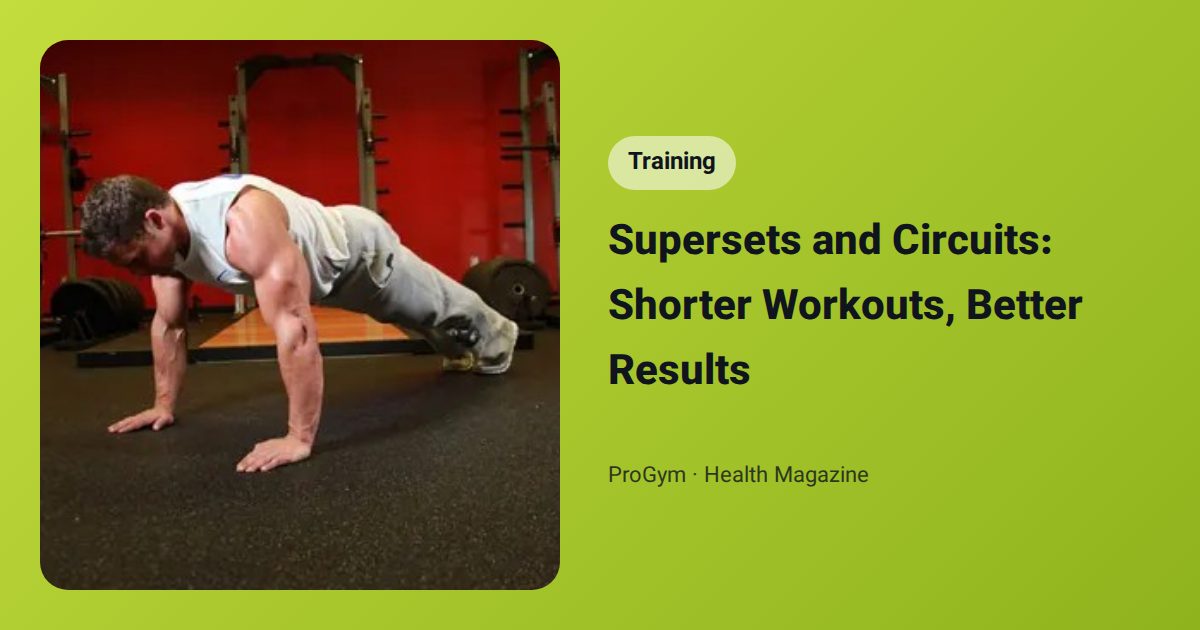
- Push-up (on your knees or hands on a sofa edge for beginners)
- Glute bridge
- One-arm dumbbell row
- Slow, controlled mountain climber
You can watch each movement with an animation in the ProGym exercise library to learn proper form.
Common superset and circuit mistakes
- Sacrificing form for speed: the goal is shorter rest, not rushed reps. Every rep should stay controlled.
- Choosing highly technical lifts: snatches, cleans and heavy deadlifts don't belong in a fatiguing circuit.
- Hogging several machines in a busy gym: at peak times, set up supersets at one station, such as one pair of dumbbells or a dual cable column, and be considerate of others.
- Removing rest entirely: rest between rounds is necessary; without it, quality drops sharply from round two.
- Ignoring progressive overload: circuits need to progress too; add a little weight, reps or an extra round each week.
Nutrition and recovery for dense workouts
Denser training demands good recovery. One to two hours before training, eat something light such as sangak bread with cheese and tomato or a bowl of low-oil adasi (lentil soup). After training, a complete meal with a natural protein source such as chicken, eggs, yogurt, lentils or beans plus some rice or bread is enough. Take 7 to 9 hours of sleep seriously. Any decision about supplements or sports medications is your own responsibility and should be made with a doctor.
Who should be careful?
Circuits raise heart rate quickly. If you have heart disease, high blood pressure, diabetes, joint problems or any other medical condition, or are pregnant, get clearance from your doctor before starting this type of training. Stop immediately if you feel dizzy, have chest pain or unusual shortness of breath. Beginners should spend 2 to 4 weeks learning exercise technique with regular straight sets first.
Summary
Supersets and circuits are simple tools for busy people. Antagonist supersets protect strength-training quality while shortening your session, and circuits create a full-body workout with a cardiovascular twist. Perform your heavy main lifts separately, superset your accessory work and aim for a little progress every week. For a program tailored to your goals, get help from the ProGym coaches.
Frequently asked questions
Are supersets as effective as regular sets for building muscle?
Yes, as long as the number of hard sets taken close to failure is the same. Antagonist supersets cause the least strength loss and are about as effective as straight sets for muscle growth, while taking less time.
Are circuits better than regular weight training for weight loss?
Circuits burn more calories per minute, but weight loss depends mainly on a calorie deficit from your diet. Combining strength training, circuits and controlled eating gives the best results.
Can beginners do supersets?
Yes, but it is better to spend 2 to 4 weeks learning technique with straight sets first, then start with simple antagonist supersets and light weights.
How many times a week can I do circuit training?
For most people, 2 to 3 circuit sessions per week with at least one day between them is enough. If you also follow a separate strength program, adjust total volume so you recover well.
Workout and nutrition plans matched to your goal and level, free.